
If you are new to driving on Italy's roads, there are some important rules, customs and peculiarities you should acquaint yourself with.
Italy’s motorways are part of an extensive network that links the country from the top edge to the heel and tip of the boot, and between the Tyrrhenian, Mediterranean and Adriatic seas.Whether you’re a foreign visitor or long-time resident, this practical guide provides tips on how to drive on Italy’s vast, if not sometimes hair-raising, motorways. Before you hop onto an autostrada or take a road trip along Italy’s scenic country roads, here are a few things you should know
Know the basic rules of the roadIn Italy, motorists drive on the right side of the road and overtake on the left. To drive you must be at least 18 years of age and hold a valid driver’s license. Whenever you get behind the wheel, you must carry an ID, car registration and proof of insurance.
If you are a visitor in the country for a period of less than 12 months, your foreign license must be accompanied by an international driving permit issued in your home country.
Wearing seat belts is mandatory for drivers and passengers, and using cell phones or other mobile devices with the exception of hands-free systems while driving is strictly prohibited
Headlights must be on at all times outside residential areas (centri abitati), even on bright sunny days.
The requirement applies both inside and outside residential areas for motorbikes and scooters; it’s also mandatory for motorcyclists and their passengers to wear an EU-approved helmet.
Be well-versed in Italian road signs, especially those indicating “stop”, “yield”, “do not enter”, “no passing”, “wrong way” and “no parking”.
For a deeper understanding of Italian road signs: Click Here
Understand Italian road categories
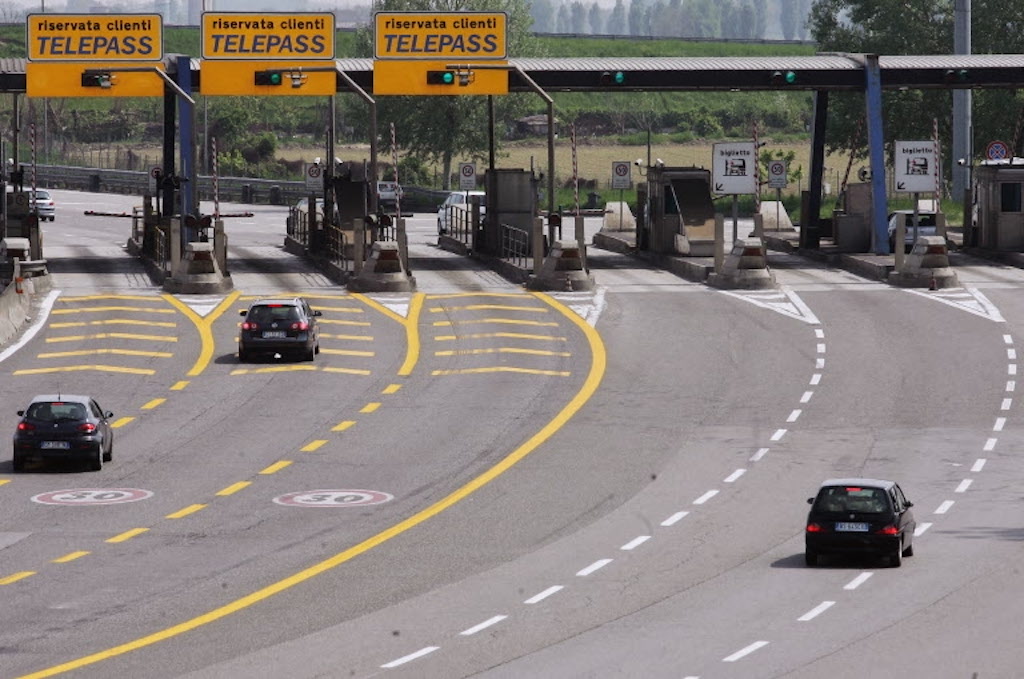 Autostrade are Italy's motorways – they'll get you to your destination in the most direct and fastest way. Named with the prefix ‘A’ followed by the number of the road (A1, A35, etc), signs indicating an autostrada are green with white text.
The speed limit on autostrade may not exceed 130 km/h and most require paying a toll at the end of the journey via cash, credit card or TELEPASS cards. (note: your American EZ Pass will not work in Italy).
If you want to avoid paying a toll, use extra-urban roads (strada extraurbana) or urban road (strada urbana).
Extra-urban roads (blue signs with white text) have a speed limit of either 110 km/h or 90 km/h depending on whether they're main roads (strade principali) or secondary roads (strade secondarie).
On urban roads (white signs with black text) the maximum speed is set at 50 km/h, though some Italian towns and cities, like Bologna, have recently introduced their own lower speed limits.
Speed limits on motorways and extra-urban roads are lower in the event of rain or snow.
Learn the protocol for merging onto motorways and roundabouts
Onramps to Italian autostrade are quite short, so be sure you have plenty of room to merge into traffic safely. Match your rate of speed with that of the flow of traffic and be prepared to stop if someone won’t or can’t let you in.
The rules for merging onto a roundabout (rotatoria or rotonda) depend on whether or not they have road signs.For roundabouts with road signs (three circulating arrows), cars traveling inside the rotonda have the right of way. Any car entering must stop and allow them to proceed before entering.If a roundabout has no signs posted, cars already traveling inside the circle must give the right-of-way to cars entering from the right-hand side.
What to do in case of an emergency
If you have an accident or breakdown, there are rest stops up and down motorways with telephones indicated by the words ‘SOS’.
You can use these to speak to an operator for help or call Italy’s Automobile Club ACI from your cell phone for assistance (803.116 from within Italy or 800.116.800 from a foreign number, toll-free).
They will tow any foreign registered vehicle to the nearest affiliated garage free of charge.
Speed cameras and checkpoints
Italians have a reputation for speeding, so the fact that there are more speed cameras installed on Italy’s roads than anywhere else in Europe may not come as a surprise.
Fines for a speed violation range from 42 to 3,382 euros depending on how much the limit is exceeded by.
Understand Italian road categories
Autostrade are Italy's motorways – they'll get you to your destination in the most direct and fastest way. Named with the prefix ‘A’ followed by the number of the road (A1, A35, etc), signs indicating an autostrada are green with white text.The speed limit on autostrade may not exceed 130 km/h and most require paying a toll at the end of the journey via cash, credit card or TELEPASS cards. (note: your American EZ Pass will not work in Italy).
If you want to avoid paying a toll, use extra-urban roads (strada extraurbana) or urban road (strada urbana).
Extra-urban roads (blue signs with white text) have a speed limit of either 110 km/h or 90 km/h depending on whether they're main roads (strade principali) or secondary roads (strade secondarie).
On urban roads (white signs with black text) the maximum speed is set at 50 km/h, though some Italian towns and cities, like Bologna, have recently introduced their own lower speed limits.
Speed limits on motorways and extra-urban roads are lower in the event of rain or snow.
Learn the protocol for merging onto motorways and roundabouts
Onramps to Italian autostrade are quite short, so be sure you have plenty of room to merge into traffic safely. Match your rate of speed with that of the flow of traffic and be prepared to stop if someone won’t or can’t let you in.
The rules for merging onto a roundabout (rotatoria or rotonda) depend on whether or not they have road signs.For roundabouts with road signs (three circulating arrows), cars traveling inside the rotonda have the right of way. Any car entering must stop and allow them to proceed before entering.If a roundabout has no signs posted, cars already traveling inside the circle must give the right-of-way to cars entering from the right-hand side.
What to do in case of an emergency
If you have an accident or breakdown, there are rest stops up and down motorways with telephones indicated by the words ‘SOS’.
You can use these to speak to an operator for help or call Italy’s Automobile Club ACI from your cell phone for assistance (803.116 from within Italy or 800.116.800 from a foreign number, toll-free).
They will tow any foreign registered vehicle to the nearest affiliated garage free of charge.
Speed cameras and checkpoints
Italians have a reputation for speeding, so the fact that there are more speed cameras installed on Italy’s roads than anywhere else in Europe may not come as a surprise.
Fines for a speed violation range from 42 to 3,382 euros depending on how much the limit is exceeded by.
If you come across a random checkpoint, you may be waved over by a police officer holding a white paddle with an orangish middle. Pull to the side of the road and be prepared to show your driving documents and other photo identification.
Pay attention to ZTL zones
Most towns and cities in Italy have areas know as zona traffica limitato or ZTL.
Generally located around historic centres, only residents or vehicles with special permits are allowed to drive in these areas during restricted time periods (when the ZTL electronic signboard says attivo, or active).
Cameras will record offenders’ license plates and issue a multa (traffic fine) via post or through the rental car company.
Beware of Italian driving habits
It usually takes some time for foreign nationals to get used to the unconventional way Italians motor about, and knowing what to expect will help you avoid surprising situations.
One of the most common quirks of Italian drivers is tailgating.
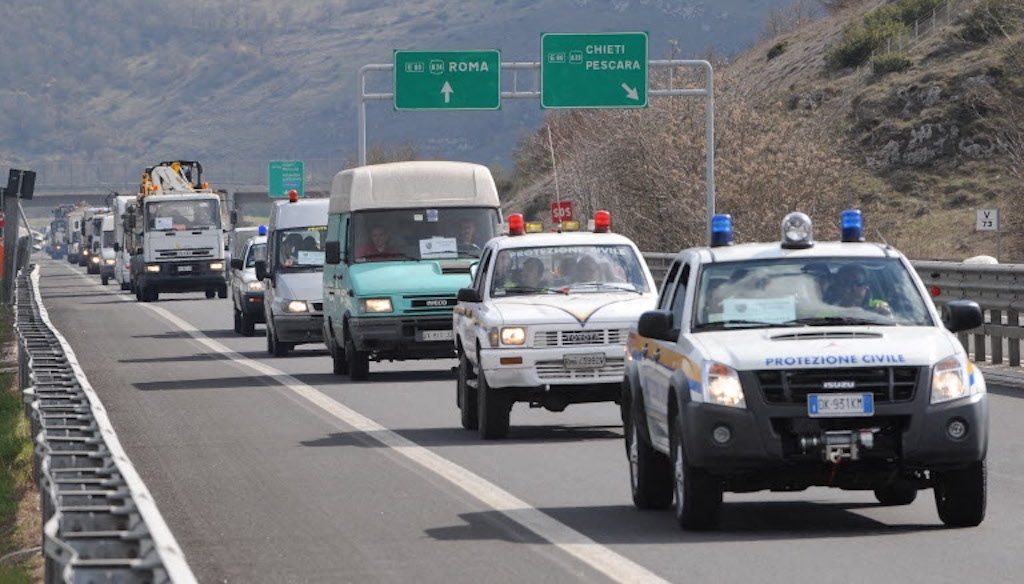
Many of us were taught that it’s prudent to leave at least two car lengths between yourself and the vehicle in front of you. That’s not really a thing in Italy.
It can be quite unnerving to have a car riding your bumper and flashing its headlights. The best thing to do is stay calm and let the car go around you. They eventually will, especially if you move to the right side of your lane a bit to indicate cooperation.
Another oddity some Italians practice is straddling lanes. You’ll often see a car driving between lines, directly above the white line, for what seems like an inordinate amount of time.
To avoid a potential collision in these scenarios, stay alert and put a reasonable amount of distance between you and the car ahead of you.
